Wednesday, January 5, 2011

Graphs from the Zombie Wars


Cross-posted at Skeptical Science.

There are a few of us who actually enjoy arguing with “climate zombies” (a term coined by Joe Romm at ClimateProgress, and one too often apt) in comments and political forums online. If you hang around long enough, you’re bound to hear some of the silliest crackpottery one can imagine. For a long time Skeptical Science has been an important resource for me, so I’m happy to have a chance to give back.


Recently, I pointed out to an adversary that CO2 and temperature were highly correlated, and to support my assertion I posted the following graph, which I did in Excel. For these graphs, the temperature data is from HADCRUTv3; and the CO2 data is from two sources: Mauna Loa (1959-2009) and the Law Dome ice core (pre-1959; using the 20-year smoothed values).


tempCO2

The blue CO2 line overlays the red Temperature line very nicely, and shows the relationship quite well. But there’s a big problem here: there is no vertical scale. And in fact, there can’t be a single vertical scale on a graph like this, because the two lines are valued very differently: temperature anomaly, in degrees Celsius, ranges between –.8 and +.6, while CO2, in parts per million, ranges between 280 and 390. In order to get the two lines to overlay in Excel, I had to alter the scale of the temperature line quite significantly, by multiplying each datapoint by a constant and adding a second constant. Ideally, I would like to put two vertical scales in place so that each line could be scaled separately. But Excel won’t allow that. Of course, adding and multiplying by constants makes no difference at all to the correlation; but my opponent was unimpressed and immediately accused me of data manipulation. How do you counter an argument like that when your opponent is nearly innumerate?


One thing you could do is draw two vertical scales on the graph, to make things perfectly explicit. Excel won’t do that, but there is other software out there that does. I happen to be familiar with GMT, an open-source mapping tool that also has extensive graphing capabilities. So let’s re-create the above graph in GMT but with two vertical scales, one for each dataset. Here is the result:


CO2

Well that’s better, but some zombies just won’t die. My opponent decided to attack the whole idea of correlation because, he claimed, the data wasn’t linear and therefore drawing a correlation coefficient wasn’t valid. The argument is utterly bogus, of course, but sometimes you can find interesting jewels even when rebutting the obviously silly. Here’s what I came up with: we eliminate the date from the graph and just plot CO2 against the global temperature anomaly in a scatterplot.


HAD-co2

Now the strong linear relationship jumps out at you as big as life and impossible to miss. I like this graph so much that the next time someone tries to tell me that CO2 and temperature aren’t correlated, or that there's no proof that CO2 causes higher temperatures, this is the first graph I’m going to use. For the entire 160-year period, the Pearson correlation coefficient r = .89, which is highly significant.


And before anyone reading this jumps on me – yes, I realize that the relationship here is based on radiative forcing, and therefore should theoretically be logarithmic and not linear. But first, the range of CO2 values is too small here to show much of a curve; and second, forcing isn’t the only factor at work: there is also feedback to consider, which might drive the actual relationship toward linear or even worse, if for example long-term feedbacks are more positive than short term feedbacks (as seems likely). So the graphed linear relationship isn’t necessarily wrong, and certainly seems empirically justified for this range of values.


One interesting thing you can do with a graph like this is to (very roughly) estimate climate sensitivity to CO2 forcing, by finding the equation of the regression line (shown in black). The equation of that line in the graph above is: T = .0085C - 2.83. From this we can determine that the mean temperature anomaly for the pre-industrial CO2 value of 280 ppm would be ‑.46, and for the doubled CO2 value of 560 ppm it would be expected to come in at +1.92; therefore doubling CO2 should raise the Earth’s temperature by about 2.38° C. This is in the ballpark of many recent (and much more sophisticated) estimates – though perhaps a bit on the low side; most recent estimates are in the range of 2° to 4° C increase for doubling of CO2, though some are as high as 6° C.


But then again, we’re using HADCRUT data, which omits much of the rapidly-warming polar regions of the Earth. We can switch to NASA’s GISS dataset, which loses 30 years of early data but which includes the poles, and draw a similar scatterplot.


GISS-co2

Here the correlation coefficient is unchanged at r = .89, but the regression slope is a little higher. For these data, T = .0096C - 3.05, and following the same procedure as above the regression line implies that doubling CO2 should raise global temperature by 2.68° C – which is still in the ballpark (but perhaps still a bit low). Still, not bad for a back-of-the-envelope calculation using publicly available data.

Thursday, February 11, 2010

It's a Byrd! It's a Plane! (Part 1)

The effect of skis on airplane performance

Lisle Rose's recent biography of famed aviator and polar pioneer Richard E. Byrd (Explorer. Columbia: University of Missouri Press, 2008) spends a lot of time in Chapter 4 defending a lost cause.

Byrd was a little-known Navy flier until 1926, when he made his reputation by flying an airplane over the North Pole – or so he claimed. There were a lot of suspicions about the flight, however, mostly based on the fact that Byrd arrived back at his base (Kings Bay, Spitzbergen: today called Ny Alesund) after less than 16 hours in the air. Critics doubted that his plane, a Fokker F7a-3m, could have flown fast enough to reach the Pole and back in such a short time.

The controversy has waxed and waned over the years, but it was decisively settled in 1998, when archivist Raimund Goerler discovered Byrd's flight diary, which contains notes Byrd made during the trip. The diary contains sextant observations and subsequent computations that had been erased. However, the erased figures are just legible, and show much different navigational observations than Byrd wrote in his official report. So it is clear Byrd falsified the navigational data in his official report.

That should end the discussion, since clearly there would be no need for data falsification if Byrd had actually done what he claimed to have done. But somehow, Rose didn't get that memo.

We will be discussing the Byrd case in detail over the next few postings, but let's start out with one little nit to pick. One of the issues Byrd skeptics raise is the fact that his plane, the Josephine Ford, was equipped with skis rather than wheels, and that this would have slowed him down. Rose is unconvinced:


Most important, however, the ski configuration on the
Josephine Ford in 1926 was slightly "up," thus providing added lift to the aircraft by facilitating airflow over the plane's big fixed-wheel undercarriage. The skis ... enhanced rather than detracted from the plane's speed.
Can it be possible that the lift from skis actually increase an airplane's speed? That seems odd, especially since Rose himself, in the very same paragraph, quotes Wendell Summers as saying that skis on his DC-3 slowed the plane's cruise from 160 mph to 145. I was able to find three other planes with published performance data with and without skis: the cruise speed of the Cessna 180J drops from 141 to 123 knots; the Cessna 185E drops from 147 to 131 knots; and the Cessna TU206 E/F drops from 148 to 132 knots. So that's 4-for-4 aircraft slowing down, and by large margins in all cases.

If we wanted to do things simply, we could just find the average percentage drop in speed for these four planes (11%) and be done with it. The Fokker F7a-3m has a published top speed of 118 mph, and an 11% reduction implies top speed with skis of 105. Byrd reported higher speeds during four hours on the flight.

But what about Rose's claim that the lift of the skis enhances the plane's speed? Well, no. The reverse is true, as engineers have known for a century. There are two sources of drag for an airplane in flight: parasitic drag, which is caused by the shape of the aircraft pushing through the air, and induced drag, which is the penalty the wings pay for lifting the plane off the ground. Parasitic drag increases with the square of the airspeed, but induced drag actually declines at higher speeds, because when the plane flies faster, the wings don’t have to work as hard to generate lift.


The equation for induced drag (Di) is:

Di = kL² / (½ ρ0 Ve²  S π AR)  

Let's work through this equation, using the DC-3 as our example. In this equation, L is the lift generated by the airplane, which for level flight is equal to the airplane’s weight (although expressed in units of force rather than of mass). It can be seen that induced drag declines as weight declines, which happens as the plane burns off fuel. The variable ρ0 is the mass-density of the air at sea level (1.225 kg/m³) and Ve is equivalent airspeed, or the airspeed shown on the airspeed indicator. The wing area S is known for the DC-3 at 91.7 square meters. The wing’s aspect ratio AR is often defined as the ratio of the wingspan to the chord (distance between the leading edge and trailing edge), but for non-rectangular wings it is easier to compute as the square of the wingspan divided by the wing area. For DC-3 with a span of 29 meters, this works out to AR=9.171. The remaining unknown is k, the lift distribution factor. For a perfect elliptical lift distribution, k=1, but elliptical wings are hard to build. Douglas built a reasonable facsimile of an ellipse, however, with a rectangular central section, a large area of taper, and rounded tips. Therefore I will assume k=1.07, which is pretty good, and much better than a rectangular wing, which would have k=1.15. With this assumption we can now compute the induced drag of the DC-3 at any given speed and weight.

Now let's look at Rose's claim by the numbers. First, it is clear that any lift generated by the skis would be lift not generated by the main wing. Given that when acting as “wings” the skis would have an aspect ratio of 0.1 or so, and that each ski is perhaps 50 times smaller than the main wing, it is frightening to contemplate the induced drag penalty any such lift would carry with it – every pound of lift generated by a ski would cause roughly 3000 times more induced drag than the wing would generate lifting that same pound. Therefore we will be generous and assume that the skis generate zero lift and zero induced drag, and that their sole effect is in parasitic drag. To determine that, we need to know how skis affect what's called the "equivalent flat plate area" of the airplane.

Parasitic drag is given by the equation

Dp = ½ ρ0 Ve² Cd A

where Cd A is the product of the parasitic drag coefficient and the wetted surface area of the airplane. We can’t determine either one of these without extensive measurements, including wind-tunnel testing. However, the product of these two numbers, called flat-plate equivalent area, can be determined using the known performance data of the DC-3 (or any other airplane), and that’s all we really need.

Let's start with the ski-less condition. Summers said the plane flew at 160 mph (71.57 m/sec); presumably this was in cruise (which we will assume is 75% of rated horsepower) and with the gear down, matching the Josephine Ford's fixed-gear configuration as closely as possible. The empty weight of a DC-3 is 18300 pounds, and its maximum weight is 25200 pounds. We will assume flying at the average of these two weights, or 21750 pounds. Converting to the metric unit of force, wing lift in level flight is therefore 96749 Newtons, and at a speed of 71.57 m/sec, induced drag is 1208 Newtons.

Total drag of the airplane is induced drag plus parasitic drag (which we don’t know yet). But we do know that the engines of the DC-3 are rated at 2400 horsepower, and since we assume cruise at 75% of that, we get 1800 engine horsepower, or 1342260 Watts. That power is passed into the propellers, which converts it into aircraft dynamic power at some less-than-perfect rate η. That allows us to compute thrust T and dynamic power Tv as follows:

Tv = Pη
or, re-writing slightly,
T = Pη / v

For most aircraft propellers, efficiency η typically maximizes at about 0.81, implying that the total thrust of the airplane would be 1342260 x .81 / 71.57 = 15191 Newtons. For an airplane flying at constant speed, total thrust is equal to total drag, and since we already know that induced drag under these conditions is 1208 N, the remaining drag (which is parasitic drag) must be 13983 N.

Having determined the parasitic drag, we now go back to the equation for parasitic drag and re-write it just a bit:
Cd A = Dp / (½ ρVe²)
and compute that the flat-plate equivalent area Cd A must be 4.46 square meters. I should mention here that exact knowledge of propeller efficiency isn’t really too critical. If we had chosen a higher prop efficiency, that would have implied a less aerodynamically efficient airplane to fly at 160 mph under 1800 hp. So a more efficient propeller means that our Cd A must increase to balance out, increasing the drag on the airplane just enough to balance the increased thrust. The two effects aren’t identical at all speeds, and in fact a slightly better prop would improve overall aircraft performance – but not by much.

Now let's repeat all that, for the DC-3 but this time with one little change: the horsepower is the same, the lift and induced drag are the same, but when we add skis, the speed drops to 145 mph, or 64.86 m/sec. We find that with skis, the equivalent flat plate area goes up to 5.93 square meters -- a whopping 33% increase.

And we can repeat the same calculation with the other three aircraft too. Here are the results:


AircraftHP Gross wt Empty wt Wing Span Wing Area Cruise mph Di Dp CdA Drag penalty
180J 230 2800 1701 10.98 16.2 162.2 92 1344 .417249.1%
180J, ski141.5121 1526 .6222
185E 300 3350 1565 10.92 16.2 169.1 102 1695 .483940.3%
185E, ski 150.7 128 1888 .6788
TU206 285 3600 1935 10.92 16.2 170.2 128 1568 .441739.6%
TU206, ski 151.8 160 1741 .6164
DC-3 2400 25200 18300 29 91.7 160 1208 13982 4.456133.2%
DC-3, ski 145 1471 15291 5.9335


So now we know (roughly) the aerodynamic effect that skis have on a typical airplane: an average increase of 40.5% in equivalent flat-plate area -- which is huge. In the next posting, we will consider how skis affected the Josephine Ford, Byrd's airplane on his 1926 flight.

Wednesday, February 3, 2010

Station dropout "problem": more non-analysis from the deniers

Earlier this week, a large, impressively-produced report was published by an outfit called SPPI, the Science & Public Policy Institute. The report was authored by our favorite data non-analyzer, Anthony Watts, and fellow denier Joseph D'Aleo. Both are meteorologists, but both are far better known for blogging than for anything else.

Their conclusion?

The startling conclusion that we cannot tell whether there was any significant “global warming” at all in the 20th century is based on numerous astonishing examples of manipulation and exaggeration of the true level and rate of “global warming”.
That is to say, leading meteorological institutions in the USA and around the world have so systematically tampered with instrumental temperature data that it cannot be safely said that there has been any significant net “global warming” in the 20th century.
Wow, that's certainly impressive. And how did they come to this sweeping conclusion? Intensive analysis of temperature records? Satellite data? Weather balloon records?

Nope. You can be absolutely sure that there's no global warming, says SPPI, because there are fewer weather stations now than there used to be.


The SPPI claim is utterly bogus of course, but it does have a patina of logic to it, at least for those unaware of how global temperatures are computed. That's because the stations that have dropped out of the Global Historical Climate Network have been largely outside of the tropics -- hence colder than the average spot on Earth's surface. As the graph above shows, when the stations dropped out, the raw, uncorrected temperature average increased. (I took the graph from the website of prominent denier Ross McKitrick, but the same graph is in the SPPI report.) So if there are fewer colder stations, the rest must be warmer, right? And that would bias the temperature record, right?

Wrong.

To understand why that's wrong, let's imagine that we're trying to find the average US temperature. Suppose we have only five stations to work with: Los Angeles airport, Newark airport, La Guardia airport, JFK airport, and New York Central Park. These five stations have raw temperatures of 83, 13, 12, 13, and 14 degrees.

If we just average all five records, we would get 27 degrees. But is that really the average temperature for the whole country? Four of the five stations are very close to each other, while the other one (LAX) is thousands of miles away. The four closely spaced stations are all measuring the same meteorological airmass, while the LAX station is measuring an entirely different airmass. In other words, these five stations have a geographical bias. If we wanted to eliminate the geographical bias, we would take just one reading from the New York area (say, 13 degrees) and average that against just one reading from the Los Angeles area (83 degrees), to get a truer average temperature of 58.

As a matter of fact, there has always been geographical bias in the collection of weather data from surface stations. There have always been a lot of stations in Europe and North America, and have always been a lot fewer in South America, Africa, and Antarctica. There have always been more measurements on land than in the sea. And there have always been more measurements in the northern hemisphere than the southern hemisphere, on both land and sea. And climatologists have always been aware of the problem, and have always corrected for it.

There is an obvious way of eliminating geographical bias from the global record, pretty much the same way we did it above: you make an average of averages by creating "gridded" data. That means you divide the Earth's surface into a grid, and average the temperatures from all stations in the grid, regardless of how many stations there are. Then you get your global average by averaging all of the grids, instead of averaging all of the stations.

Note for math geeks: there is one more step to getting an accurate global average from gridded data, and that is weighting each grid by its area. Since grid lines generally follow latitude/longitude lines, those grids at higher latitudes are physically smaller than grids near the equator, and you allow for that by creating a weighted average.

The beauty of gridded data is that it doesn't matter how many stations there are. In the example above, we could safely eliminate three of the four New York area stations without compromising data integrity, and without changing the gridded average -- even though the raw, ungridded average would increase sharply. In fact, the raw ungridded data would increase in pretty much the same way that the raw ungridded average in McKitrick's graph does. And it would be just as meaningless.

So Watts and D'Aleo have asked the wrong question. Instead of asking if the dropout stations are primarily northern (they are: during the Great Dropout of 1990, most of the dropped stations were in China, Turkey, Ireland, and Canada), the proper question to ask is: does the dropout create bias in the gridded average? And the answer to that seems to be no. The vast majority of the dropped stations were in regions of the Earth that were already oversampled, just as New York was oversampled in the example above. In other words, the primary effect of the dropout was to reduce the geographical bias in the data. Which is good, not bad.

We can test this hypothesis very easily using the five global temperature datasets. Three of the five depend on surface station measurements, while the other two are based on satellite data. Looking at the graph above, it is clear that the big effect, if any, must have happened between 1989 and 1990, when the raw (ungridded) average took a huge leap. What we want to know is: did the final gridded data also take this same leap at the same time? Because if it did, that would imply that the station dropout is really something to be concerned about.

Here is the monthly global average temperature during 1989 and '90, according to the five global temperature datasets:

Take a look at the right half of the image, which is the key year 1990. That's the year the Big Dropout began, and that's the year that shows the biggest jump in the raw, ungridded temperatures, according to McKitrick's graph. The bottom two lines, yellow and red, are the UAH and RSS satellite-based global temperatures. The upper three lines are the three global datasets that depend on surface stations. Notice anything interesting?

During the critical year 1990, the gridded surface station temperatures actually declined -- got cooler -- as the satellite temperature record got warmer.

So, did the Big Dropout cause global warming? No. In fact, if anything, the Big Dropout caused global temperatures to bias cool rather than bias warm.

Can SPPI, Anthony Watts, and Joseph D'Aleo actually do mathematical analysis of global temperatures? Apparently not.

Tuesday, February 2, 2010

Watts up with Watts?

Global warming denialists have, over the past several years, pointed their accusatory fingers at poorly sited US weather stations which (they claim) have biased recent US temperature records too warm -- and which, deniers claim, is the basis for the alleged "hoax" of global warming.

Led by talk-radio weatherman (and college dropout) Anthony Watts, website surfacestations.org has rushed to publish photos of US weather stations sited next to air conditioners and parking lots. Of course, changes in station siting conditions are easy to identify with simple statistical methods (and climatologists make such corrections routinely); and of course, the US makes up less than 1.5% of the world's surface anyway. But deniers have never been big believers in, you know, math and logic.

Fortunately, there are real scientists who are. And those poorly sited stations? Turns out they're biased, all right. On the cold side.

"I believe we will be able to demonstrate that some of the global warming increase is not from CO2 but from localized changes in the temperature-measurement environment."
Anthony Watts in 2007, when his surfacestations.org website launched


So after two years of photo collection, we have a right to ask: where's the demonstration we were promised? And the answer seems to be: in spite of the complaints about siting, Watts can't find anything wrong in the actual data. Because if he could, you can bet he would have been talking about it by now.

Deniers have two big beefs with US climate data. First is the siting of stations, as mentioned above. Second, they just can't understand why NOAA adjusts their data instead of using raw data. In the deniers' conspiratorialist minds, the only reason NOAA would adjust the raw data is to perpetrate the global warming "hoax". The fact that both raw and adjusted data is freely available from NOAA, where anyone can see it, seems to make no difference to them. Among the deniers publicly complaining about NOAA's data adjustments are E.M. Smith and Joseph D'Aleo.

Of course, the real reason adjustment is done is to take account of exactly the kind of things Watts is complaining about. When a weather station is moved, or a new thermometer is installed, it will often be biased (compared to the old site or the old instrument). Such biases are easy to spot in the data, however — you just compare the average temperature differences between the station and its nearest neighbors before and after the change. Then you adjust the new readings to account for the bias.

In the late 1980's, a lot of stations had issues of this kind, as standard methods of temperature collection in the US changed with the arrival of personal computers. The old way of doing things was the classic "Cotton Region Shelter" (CRS), that white box with louvered sides sitting off in a field next to a runway somewhere. The CRS is great, as long as you have a large and dedicated staff that can go out and check the thermometer 24 hours a day, seven days a week. But a lot of smaller stations don't have that many people, or that much dedication.

So the new computerized method is the Min-Max Temperature System (MMTS), which can catch the daily highs and lows even if they occur when the hour hand is somewhere other than 12. The problem with MMTS is that it requires a cable to connect it to a computer, and there is a limit to how long that cable can be. Which means that the MMTS instruments tend to be a lot closer to buildings (and their parking lots and air conditioners) than the old CRS thermometers they replaced. Result: Anthony Watts and his minions have a field day with their cameras and their carping.

But the question we need answered is, does it really make a difference? NOAA scientist Matthew J. Menne has taken Watts' siting criticisms seriously. Last summer he took a look at the difference between the best-sited stations and overall US temperatures and found no difference between them. Because Watts' blog was so frequently cited, Menne chose to publish his preliminary findings in an online FAQ prior to peer-review. But now his completed paper has been accepted in the Journal of Geophysical Research — Atmospheres. Menne used Watts' own evaluation of surface stations (rated from 1, best siting, to 5, worst siting) and divided US weather stations between "good" sites (rated 1 or 2) and "bad" sites (rated 3, 4, or 5).

Menne and his colleagues then compared the good sites against the bad sites and found — AHA! — there was indeed a difference between the two, when you look at the raw, unadjusted data:
Menne_umax

... but the poorly sited stations are actually warming more slowly than the best sited stations! And just to drive another nail into the coffin, the difference virtually disappears after NOAA's data adjustments are done:
Menne_amax

If you look back at the first graph, you will see that nearly all of the differences between good and bad sites occurred in the period 1985-87, when the big changover to MMTS happened. The reason for the difference is that MMTS intstruments do tend to have a bias compared to the CRS thermometers: the MMTS daily highs aren't as high, and the daily lows aren't as low. But the difference between daily highs is greater, which is why the MMTS instruments' raw data is biased cool.

So climate deniers fail twice: global warming is real, not just an artifact of poor sites and bad data. And, NOAA's data adjustments work pretty darn near perfectly too.

Monday, February 1, 2010

Earth's Hottest Day?

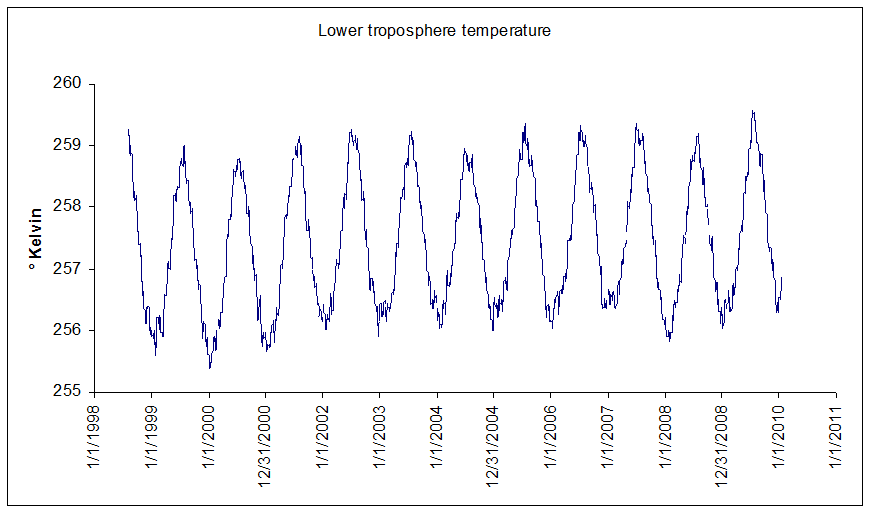
I just ran across a climate dataset I had never seen before: the daily global temperature reading, as deduced from earth-orbiting satellites. It's available here, from the University of Alabama-Huntsville (UAH) website. Here's the raw data, which I've plotted on this graph.
UAHdaily

The most obvious thing about this record is its seasonal nature. It's colder in the (northern hemisphere) winter, and hotter in the (northern hemisphere) summer.

But (I hear you cry) since it's a global dataset, when it's winter up here, it's summer down there. So shouldn't that cancel out?

Well, no. Water has a lot of thermal inertia: it takes a long time to heat up, and a long time to cool down. Land responds much faster to heating and cooling. And there's a lot more land in the northern hemispere, so even a global dataset will follow the northern hemisphere seasons. And that's annoying, because the seasonal "noise" swamps the more interesting long-term signal that we're looking for. So what we really want to do is to remove the seasonal component entirely.

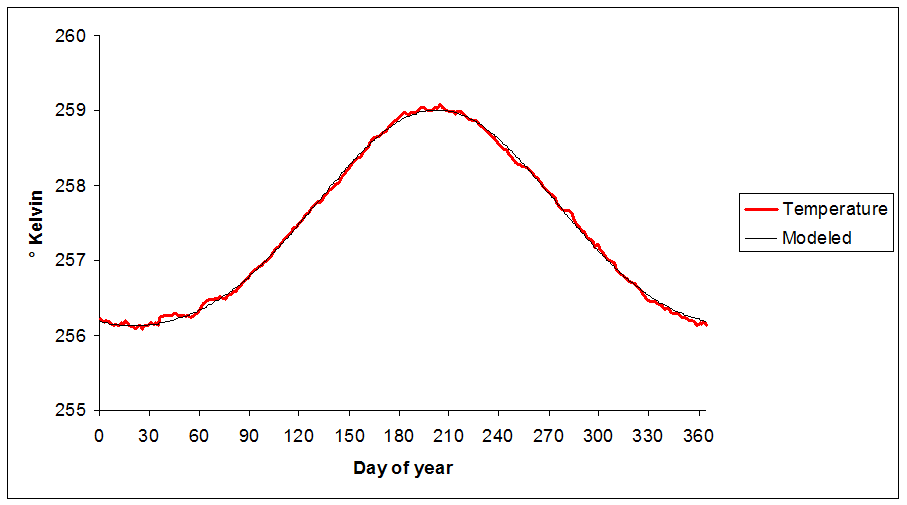
Here's how we do that. We start by averaging the satellite temperature for each day of the year. We have a little more than 12 years worth of data, so we average all of the January 1 data (regardless of year), all the January 2 data, and so on. (I removed February 29 from the dataset, because there are only 3 of them, which is really not enough for statistics). When we do that, we get this really nice seasonal curve:

UAHseasonal

The red line is the average temperature for each day of the year. It's almost a sine wave, but it also has a sine-squared component. The thin black line is a mathematical model of the red line. For you math geeks, it's given by the following equation:

Temp = a1 * sin((day + phase) / L) + a2 * sin²((day + phase)/L) + offset

... where phase is -111.5187 days, L (inverse frequency) is 58.09 (or 365/2π), offset is 257.269, a1 (amplitude of the sine component) is 1.4401, and a2 (amplitude of the sine squared component) is .3024 .

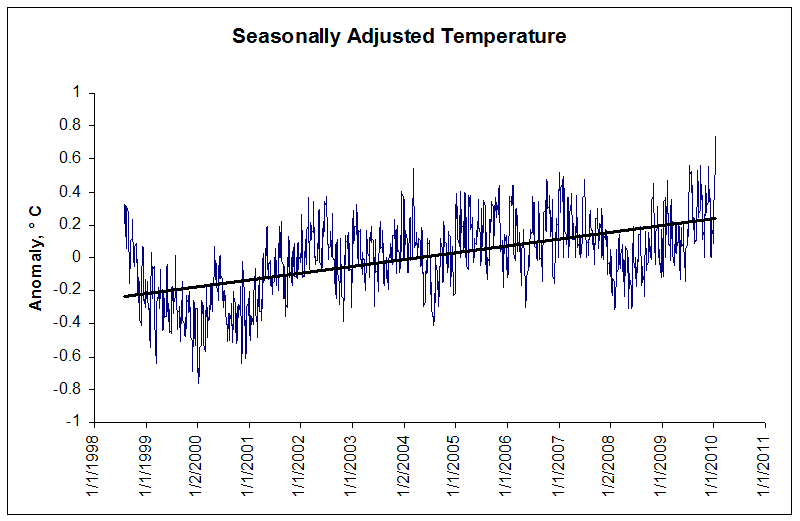
As you can see, the black line replicates the seasonal variation very exactly. So now, we can subtract the "expected" temperature on a given day (computed from our equation) from the actual measured temperature, and we will have a nice view of global temperatures with the big seasonal wave removed. It looks like this:

AdjTemp

A few things to notice here. First, the blue line (seasonally-adjusted temperature) starts on a downward trend in 1998 and 1999. That's because 1998 was (at the time) the hottest year on record globally, propelled by a massive El Niño. So yes, '99 was a definitely cooler than '98. Notice also how generally warm 2005 was (almost entirely above the black trend line); no surprise, '05 was either the first or second hottest year on record, essentially tied with 1998.

Now look at the rightmost end of the graph. That's where we were on Saturday, January 16, 2010. After adjusting for normal seasonal effects, it's the hottest day globally in the history of recorded temperature measurement, according to the UAH daily dataset. Prior to this week, the record had been held by March 9, 2004, an anomaly of .54 degrees (compared to the 1998-2010 average). That record was nearly matched on July 19, 2009. But the record was decisively broken twice several times during mid January, most decisively on Saturday, January 16, when it reached .75 degrees.

Another disturbing trend: the black line, which is the regression line for the series, has a slope indicating an increase of over 4°C per century. And thereby hangs a tale: because, as we shall see, that's a trend far above the standard UAH global dataset. Which means there's something interesting going on.

If I were a denier of the Anthony Watts or Joseph D'Aleo class, I would cry "Conspiracy!" at this point. But the truth is almost certainly far more benign, as we shall see.

Why this blog is needed


I wear a lot of hats. When I draw my paycheck, I'm a computer IT consultant. I live on a small farm in Minnesota and so I'm familiar with tractors, snowplows, and snowmobiles. For a couple of years in the late 1980s, my wife an I put our thoroughbred on the track. I've been an amateur astronomer my entire life, which led to an interest in all sorts of optics, including photography. I was a four-year National Merit Scholar in college, back in the experimental 70's when the idea was to let students design their own course of study. As a result of that, I'm sure I was the only theater major at KU who took courses in calculus and FORTRAN. I enjoy working with fluid dynamics as a hobby.

But on the internet I'm best known as a historian, particularly of Christopher Columbus. My site, the Columbus Navigation Homepage, grew out of a longstanding controversy over the location of Columbus's first landfall in the New World. I got involved in the controversy in 1992, at the time of the 500th anniversary of Columbus's arrival, and for a few years afterward was part of an informal committee of correspondence (by snail mail: this was still pre-internet) on the topic. I've also been interested in the history of polar exploration and the Ancient Star Catalog, and the history of astronomy and navigation in broad terms.

All of these historical interests have a common theme: there is a controversy or a dispute, and key points of the dispute can be resolved by cogent mathematical analysis. Sadly, most historians are not mathematicians, and most mathematicians are not historians. If you need expertise in both, you may be out of luck. Or you can call me.

Lately I've been interested in climate change, which (no surprise) is a number-rich environment, and contains elements of historical interest as well. In my first few posts I'll be taking a look at some aspects of climate change, and what passes for analysis among the well-funded think-tanks of the denier right wing.